Sunday, February 9, 2014

Chapter 7 Maternal Mortality and Edna's Hospital


"You are the pioneers." -Edna Adan to her graduating class of midwives

Class discussion commenced with a video clip from the documentary Half the Sky, which follows Nicolas Kristof on his journey to some of the countries he writes about in the New York Times and the novel, Half the Sky. The particular clip from the movie we watched chronicled Kristof in Somaliland accompanied by actress Diane Lane. The two visit Edna Adan and the hospital she founded to combat maternal mortality in a country that is not even recognized by the rest of the world.

Edna Adan grew up in Somaliland and was the first girl from her country to win a scholarship  to study in Britain. When Edna was eight years old her mother forced her to undergo Female Genital Mutilation (FGM). Edna's father returned from out of town livid the practice was performed on his daughter. Edna realized that if her father, an educated doctor, denounced FGM then surely what happened to her was wrong. A father's love influenced Edna Adan to become a voice for victims of FGM. Edna  provided astonishing insight into FGM which is a practice that 3 million African girls are forced to undergo every year. The trauma their bodies experience during the process leaves a lasting impact on the reproductive organs, therefore leading to an increase in the number of childbirth deaths. A question brought up in class asked us to consider ways to stop the practice if acting with U.N. power. A student pointed out that the foot binding process was eradicated in China once people realized some of the negative effects which occurred later in life. Those in areas where FGM is occurring need to grasp that FGM leads to long lasting impacts and increases the chances of maternal mortality. Educating communities that view FGM as status quo is a necessary step to eliminate the horrendous act. 

Here is a link to the website for Edna's hospital to learn more:


The class also discussed the varying reasons why FGM occurs and observed from the film three main reasons: tradition, religion, and money. Edna explained that Islam does not encourage FGM and that the practice is a matter of tradition. Though this point is valid, a student noticed that the local woman that Diane Lane and Kristof talked with said she would prohibit her son from marrying an uncircumcised girl because of God. Another perspective was brought to light when the pair met with a woman who performs FGM for a living. Both Lane and Kristofs’ jaws dropped as the woman told them she performs over 10 FGMs per day. Lane inquired further into the woman’s financial motive and realized the woman would not perform FGMs if she could make her money another way.


I would highly recommend taking a look at this link to an article from the U.N. which was posted the day after our last discussion. The site includes an interactive map where you can choose a country and learn about the prevalence of FGM in that country, the number of religious leaders who have denounced the practice, and whether any laws exist there prohibiting FGM.  http://www.un.org/apps/news/story.asp/www.wmo.int/story.asp?NewsID=47092&Cr=genital&Cr1

Chapter Seven also followed the story of Prudence, a young women in Cameroon who died after being taken to a hospital for childbirth complications. The doctors were not compelled to help her and Prudence’s husband was educated enough to notice the injustice occurring. As a class, we discussed that if Prudence had been male, her family would likely have made more of an effort to find the funds to get her to a hospital sooner. A classmate pointed out that a relative of Prudence’s used a cell phone, implying that the family possibly had more money for the surgery than they let on. The tale of Prudence is one that happens every minute all over the world. A woman is not just dying because of childbirth, she is dying because she is a woman.

“Giving birth should be your greatest achievement not your greatest fear.” ~ Jane Weideman 

Monday, February 3, 2014

Chapter 5 Understanding Historical Oppression

Chapter 5 of Half the Sky explores how "honor" is seen different for women. Throughout the chapter, women had standards that they all must follow in order to be treated fair. The standards on these women objectify their physical looks in relations to their purity. They were shamed in the utmost dehumanizing ways if they had lost their virginity before marriage. Women became targets to shame clan. Du'a Aswad was a seventeen year old teenager who lived in Congo. When her husband found that she was not a virgin, he demanded for a honor killing. If a women cannot hold their purity, the only honor for them would be death. People develop "codes of sexual honor" that are suppose to help women but instead women are systematically dishonored.

In class, we watched some videos, discussed US/foreign involvement, and dialogues about the chapters. When I was reading the chapter after the presentation in class, it made me wonder how these systems of sexism were formed. I wanted to know more about the historical context, especially with foreign country involvement. What I mean is that in the novel Congo is famously known for sexual violence. Did colonization play role in developing systems of sexism because Africa was heavily colonized and abused by European countries. And if colonization did play a role, how does Europe take into accountability for the sexual violence that exist in Africa? What would make this book better if they could give the reader brief historical context of how sexual violence was implemented into systems instead of saying it is because of religion or culture. In order to understand sexual violence, an understanding of its root causes and history will help.

Written by Kevin Vang

Sunday, February 2, 2014

Chapter 6 -Maternal Mortality, One Woman a Minute

The discussion of Chapters 5 and 6 began with a video,
http://www.youtube.com/watch?v=tS3VDKI9Hg0&app=desktop#!

Then the class continued with an activity, where each classmate wrote down one positive thing that they experienced or witnessed men do, followed by one negative thing, some classmates shared what they wrote down and it was briefly discussed in class. Positive things were actions such as "opening/holding doors for women" and negative things were doings such as "overpowering women". Each classmate that shared out loud or participated in discussion received a piece of candy as a reward. This activity was done in order to educate others to be cautious instead of paranoid when it came to men, as well as teaching that men are not bad. There was another video showed following the activity:

http://www.youtube.com/watch?v=FgbCQMw5LOM

After the video, the class numbered off by 1's and 2's, 1's discussed why the US should get involved in stopping practices such as honor killings, and 2's discussed why the US shouldn't get involved in stopping honor killings. After the discussion, the two sides had a debate about the issues. After the discussion of the issue was complete, questions about the chapter were asked.

"After seven days, Mahabouba fell unconscious, and at that point someone summoned a birth attendant. By then the baby had been wedged in there for so long that the tissues between the baby's head and Mahabouba's pelvis had lost circulation and rotted away. When Mahabouba recovered consciousness, she found out that the baby was dead and she had no control over her bladder or bowels. She also couldn't walk or even stand, a consequence of never damage that is a frequent by-product of fistula." (p. 94)
The class discussed whether the students knew what fistulas were prior to taking the course, the entire class answered "no" to the question and the discussion of why there weren't programs for it began.
Some students mentioned how if fistulas happened to men, there would be more funds for the issue. Majority of the class agreed.

"She's helpless, she's voiceless . . . the reason these women are pariahs is because they are women. If this happened to men, we would have foundations and supplies coming in from all over the world." (p. 97)
After the quote, the class discussed everyone's views as to why there aren't more foundations to help women with fistulas, and how societies view women as lesser.

"Conservatives battle forced abortions in China, and liberals fight passionately for abortion rights in foreign lands. But meeting the challenge of women dying in childbirth had never had much of a constituency." (p. 98)
The class discussed how both political parties are missing actual risks, such as women's health during pregnancy.
At the end we discussed how US has a low mortality at birth rate.

Chapter 6 discussed how hazardous giving birth in 3rd world countries is, and how we can lower mortality rate abroad.

My name is Leah Silkina and I hope everyone had a great weekend!

PS. Here are some links to volunteer and help abroad!
http://www.africa.upenn.edu/Travel/Volunteer_Work_9979.html

http://www.projects-abroad.org/volunteer-projects/medicine-and-healthcare/medicine/

http://www.travellersworldwide.com/

http://guides.lib.unc.edu/content.php?pid=133526&sid=1148466

http://www.volunteerinternational.org/resources.html "

Sunday, January 26, 2014

Chapter 4, Rule by Rape


           Chapter four of Half the Sky begins with a quote by Even Ensler: “The mechanism of violence is what destroys women, controls women, diminishes women and keeps women in their so called place.” This powerful quote speaks to the root of the problem- as long as women are beaten down and then held there, not by the perpetrators, but by ideals and stigmas of their world, the issue will never resolve. Gender based violence, especially the unfair stigmas attached to the victims of rape, is a large focus in the chapter. The stories of two courageous women who overcame these obstacles after facing rape, Mukhtar Mai and Woinshet Zebene, were the highlights of the chapter. Their incredible journeys show the possibility for all women to fight to change their fates after suffering gender-based violence if they are empowered to do so.

            Woinshet Zebene, a young Ethiopian woman, was to be forced into marriage by a suitor Aberew by a particular law stating that no man could be prosecuted for rape if he later married the girl he violated. By kidnapping and raping Zebene, he aimed to ruin her chances at marriage to anyone else because she would no longer be a virgin. In the chapter, Kristoff says that families on both sides essentially let this happen: it does not appear that the rapist’s family stands against him and the girl’s family is usually too ashamed to speak out (although in Zebene’s case, she sought justice with her family’s support). This lead to collective disbelief amongst the class in response the familial role in this outdated law- how could they stand by and watch something as medieval as this unfold before their eyes? Did they not think it was wrong? After class ended I researched more into this Ethiopian rape law and found an interesting article that shed more light on the law and, in particular, Zenebe’s case.

            The link to the article can be found here: http://www.equalitynow.org/node/264

The class found it particularly frustrating how the judge and officials who Zenebe went to expecting justice simply told her to comply with Aberew’s wishes. Says one official, “Even if you go home, Aberew will go after you again. So there’s no point in resisting.” The judge on the case, who was opposed to prosecuting the rapist said to Zenebe, “He wants to marry you. Why are you refusing?” 

It was apparent to everyone that corrupted officials paired with outdated, sexist laws create an unsafe environment for women to live in. What would it be like if judges, officials, laws, etc. were like that here in US? After this question was posed, it seemed the class came to a general agreement that it would be chaotic. There would be women here like the ones in the book giving up and accepting their fate, feeling helpless and resigned. When no one is on their side, the law is of no help, and their families are too ashamed to speak up, it is not hard to imagine a world similar to the ones we read about.

It is not to say that sexist beliefs, laws, etc. do not exist in the US. The major discussion topic that arose from the question of the existence of such domestic opinions came to the widely publicized case of the Stuebenville high school rape case.


“A judge found two Steubenville star high school football players guilty Sunday of raping an allegedly drunk 16-year-old girl,” the article reads. A classmate brought up something they found particularly offensive: while watching a news story covering the case, it seemed as though the football players were being sympathized with and the girl was painted in a negative light. This certainly sparked an interesting conversation about how, even here in the US, the victim of rape is sometimes seen at fault for it. Even though it seems nothing as extreme as the Ethiopian rape law occurs here in the US, it is the general attitude toward rape that needs continual progress.

A somewhat divided class then began discussing the topic of the idea that as westerners we try to change the laws and not the culture. One woman who’s story is told suffered through great abuse at the hands of her husband’s family—yet even she said that the husband may reserve the right to beat his wife if she is disobedient. It was apparent that this was a cultural, even perhaps a religiously based, belief. Is it right to attempt to change their deep rooted principles and way of life? Some argued strongly that it is immoral and wrong to go in and attempt to change a people’s culture- it is their decision and free will to live how they want. It was opposed by the argument that perhaps if we changed only certain aspects of a culture (i.e., reduce the acceptance of misogynistic practices like beatings and rape) it would be beneficial in the larger picture. As Sunitha elaborated in her TED talk: we must change the “culture of silence.” In perhaps moderate agreement, it was said that we can try to influence opinions but we cannot always change foundations.

One student elaborated on this cultural debate with an example of a analogous situation dealing with inferiors not speaking up against their elder. Doing so could have saved their lives, but, because of a cultural belief, they were taught it was unacceptable. This same situation could be applied to young girls globally who are not speaking out against gender based violence because they are taught not to do so—that it is shameful and dangerous. If we could only teach these girls to speak up, to educate them between what is right and wrong, to empower them, we can make a difference. It would not be changing the entire culture or their way of life, but altering an aspect of it to improve the safety and well-being of these girls.

The discussion ended on an idea that seemed to resonate with everyone: it is not external pressure from the US that will generate change but the people on the inside. Wonderful, courageous people like Sunitha, Zenebe, and Mukhtar that make programs successful are the ones to set precedence for others to follow. It is a global struggle that must be fought from the inside out and if we continue to fund and empower these life changing people, progress can and will be made.
~
As a class, we did not discuss Mukhtar’s story in great depth, but a link to her organization’s website where you can read further into the cause and donate can be found here: http://www.mukhtarmai.org

Thursday, January 23, 2014

FYS – Half the Sky ~ Chapter 3: Learning to Speak Up

Here is an informative page from the United Nations Population Fund about gender-based violence: http://www.unfpa.org/gender/violence.htm.

~

At the beginning of our discussion, we were presented with three questions:

1) If you were walking down the street and you saw a woman getting beaten up by two men, would you speak up?

2) If you were walking down the street and you saw a woman getting beaten up by two men, but you knew if you spoke up then you, too, would be beaten, would you speak up?

3) If you were walking down the street and you saw a woman getting beaten up by two men, but you knew if you spoke up then your family would be in danger, would you speak up?

The majority of our class was willing to speak up in scenario 1. When personal safety became a risk in scenario 2, most people said that they would still speak up, but perhaps look for assistance through another figure to address the issue. When an entire family became involved with the situation in scenario 3, most people were less inclined to speak up altogether.

This exercise reflects the fear that many people feel toward speak out against issues in our world today. Silence is the unfortunate result of this fear. Most are unwilling to speak out against sex trafficking, child labor, cutting, and other issues because they are scared of the repercussions. Understandably, people will not sacrifice their family’s safety for the slim possibility of positive social change.


This video shows how people often ignore situations around them because they fear what will happen if they become involved. In this context, the subject is bullying. In our class discussions, the subjects are human sex trafficking, prostitution, and rape.

As somebody pointed out during our discussion, we have been educated to help others; however, some people lack the education to make the right decisions. It is important to recognize that, even with education on our side, we often fail to make the right decisions in practice. Knowledge must be spread in order for it to be received. For instance, women would benefit from learning about the health consequences of having unprotected sex before they engage in that risky activity.

How can we find a balance between education, morals, and safety while being culturally sensitive?

~

Chapter 3: Learning to Speak Up, documented inspiring stories of empowered individuals. These stories showed how single beings could truly make an impact. Moreover, hearing single cases allowed us, as an audience, to connect to these stories.

Usha Narayane organized her town to riot against the corrupt gangster, Akku Yadav. Hindered by a lack of police intervention, Usha took it upon herself to organize the murder of the threatening figure.

As a class, we debated if homicide was justified in this case. We decided that, while we do not condone murder, the act was more associated with self-defense because the authorities were not stepping in to protect the locals from the dangerous Akku Yadav and his gang.

Sunitha Krishnan is a passionate leader working to fight commercial sex trafficking and empower women. Her story is included below.

In the United States, Zach Hunter founded Loose Change to Loosen Chains (LC2LC), an organization that works to fight modern slavery.

~

At the beginning of Chapter 3, women are described as docile and submissive. As a class, we were asked if we believe that women in the United States today follow this stereotype.

At first, we said no. Women in America are more progressive than in most parts of the world; however, there are certainly more progressions that must take place before we declare equality between the genders. First of all, it was mentioned that we have never had a female president, inequality exists in the workforce, and some legislation appears to be gender-biased. We also talked about how women and men have different physical makeups; this reality is often associated with the discrimination that women and men face. For instance, women may be looked down upon for lifting weights in the gym and men may be ridiculed for styling their hair in a certain way.

In addition, there are gender-specific personality traits that relate to how an individual is perceived by others. Gradually, in the U.S., most of these distinguishable characteristics are becoming more gender neutral. In some cases, however, factors such as culture and religion influence “gender roles.”

Somebody brought up the idea of an extreme version of feminism, where advocates are deemed “feminazis.” These individuals are women’s rights activists who want all resources to be allocated toward women, rather than both genders equally. This led us to look up the definition of feminism, since it is often portrayed as a somewhat negative word. Feminism is defined as “the advocacy of women’s rights on the grounds of political, social, and economic equality to men” (New Oxford American Dictionary). So it is about equality, not overpowering.

“I do not wish them [women] to have power over men, but over themselves.” --Mary Wollstonecraft

~


We watched a TED Talk video, where Sunitha Krishnan spoke about the terrors of sex slavery. She explained how children as young as three, four, or five years old are sold into commercial sexual exploitation. She also addressed the issues of prostitution, disease, and rape.

Sunitha herself was gang raped by eight men at the age of fifteen. She described how the anger has stuck with her because, as a result of their actions, she was ostracized, isolated, and treated like a shameful victim.

She went on to explain how our society treats the targets of rapes as the victims of rapes. Women are often disregarded, punished, beaten, or killed for being targets. Moreover, they are seen as less than human, and all of this is entirely out of their control.

Sunitha has rescued over 3,200 girls from ages three to forty years old. She points out that silence kills. If we do not speak up, we are letting people get away with crimes. Women involved often suffer from sexually transmitted diseases, drug addictions, or substance abuse because they see no potential from their deemed “ruined” state of being as a raped or mistreated individual.

Sunitha admitted that her initial thought when helping women was “where do I begin?” Sometimes, it seems like one person cannot make a meaningful difference, but individuals such as Sunitha have proved this mentality wrong. She explains how understanding her personal pain was her best teacher. Now, Sunitha gives women the resources and power to work in carpentry, welding, construction, and other fields. She gives them an alternative to selling themselves. She notes that confidence and dignity are crucial components to building strong, capable women.

One of the most meaningful portions of the video was Sunitha’s request for acceptance. She urges the public to have open minds and open hearts because women who have been raped want compassion. They want to belong and they deserve to belong. As a voice for all survivors of human trafficking, Sunitha presents a powerful and humble plead for change in the way we treat women.

Our class felt that the video’s graphic images worked to show the realities associated with trafficking and the severe consequences of silence. Sunitha talks in a way that makes the audience feel like they “own the cause” and are within reach of changing the current situation. She states: “I don’t want to hear 100 ways you can’t do something; I want to hear 1 way you can.” She highlights that passivity itself is a form of corruption. She stresses that she is not a victim, and it is displayed through her passion and humility as she speaks. Sunitha’s story, which includes the extension of thousands of other girls’ stories, works to establish a level of connection. As an audience, we respond because she is one person, not a meaningless statistic. She breaks the barrier of a numerical figure attached to sex trafficking because she is one example, who happens to be latched to many other examples; each story is a painful reminder of the brutality we allow to occur. She kindly asks for our cooperation in ending this hostility, and we are more than willing to oblige.

~

In the last portion of our discussion, we talked about ways that we could get involved with helping empower women globally. We discussed the following organizations:

-Kiva is a program where volunteers fund microfinance loan projects abroad.

-Women for Women International provides support for female survivors of war.

-Three Cups of Tea works to promote girls’ education, literacy, and peace.

-Tinogona inspires universal access to quality education. It is Davis Rotaract’s current project.


Monday, January 20, 2014

The Starfish

FYS – Half the Sky: Kristof Talk/Chapter Two

“A man goes out on the beach and sees that it is covered with starfish that have washed up in the tide. A little boy is walking along, picking them up and throwing them back in the water.
            “What are you doing, son?” the man asks. “You see how many starfish there are? You’ll never make a difference.”
            The boy paused thoughtfully, and picked up another starfish and threw it in the ocean.
            “It sure made a difference to that one,” he said.” (Kristof, WuDunn Page 45)

Last Monday, the class attended a talk held by the author of the novel Half the Sky, Nicholas Kristof. His brilliant speech didn’t hold anything back as he discussed the ways in which women are being held against their own will in foreign countries. He explained the ways in which he strived to help others, and how much the world needs to make a difference. One of the most important and correlating facts between the most recently read chapter (2) and the talk was the idea of helping the individual. Sometimes, starting small may be the only way to make a difference at all.

This issue of human trafficking should not be focused on by only a select group of people; the entire world should be involved: this is as much a gender issue as it is a class issue, as we discussed in class. Unfortunately, we faced an ultimate reality check as we discussed the Indian police encounter in the beginning of Chapter 2.

Why is it that in other countries, the police force is so inadequate?

As we talked about this, we decided that there needs to be a way to cause the police in other countries to be more inclined to stop human trafficking rather than simply look for pirated DVDs or other illegal items. Despite this, we did realize one important fact, the U.S. has a huge impact on our surrounding world. Why hasn’t the U.S. stepped in to aid with the trafficking and support the police monitoring system? There’s one simple answer: greed. The U.S. cares more about the pirated DVDs than the women because that gives us additional revenue that we somehow cannot live without. We are acting as if prostitution is inevitable; as addressed in the novel, what are men supposed to do between the ages of 18 and 30 if there is not prostitution?

This needs to change.

One of the more heavy topics we discussed was the idea of legalization or prohibition of prostitution in order to alleviate the problem. Kristof discussed this in his speech as well, which correlates perfectly with this chapter. The class came to a more general consensus as we realized that the best decision for a country is more based on the country itself, its surroundings and the internal governmental structure. As the Netherlands legalized prostitution and Sweden prohibited it, the result was quite clear: Sweden had the biggest decrease in prostitution.

Why?

Well, it’s simple. In Sweden, the demand for prostitution decreased as more and more Johns were arrested. In the Netherlands, it almost became easier to find a prostitute.

Despite this, an interesting point brought up by one of the students in class was the idea that “women are in charge of themselves” and for this reason, it should be legalized and regulated from there. Both countries attempted to change the outcome of forced prostitution but as said in class, “no matter what, there will be a black market for prostitution regardless of how they try to change  it”. Each theory poses strong evidence as to why it would work, but the fact is that without enforcement of the particular resolution, nothing will change. Nothing will change unless action is actually taken.

Here is an interesting website that compares both the pros and cons of legalization if you would like to read more: http://prostitution.procon.org/view.answers.php?questionID=000243

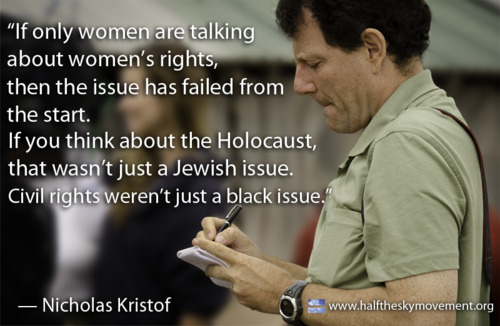
Another point brought up by one of the students was the need to educate men and raise awareness across all borders. This is definitely supported by Kristof as the quote on the top of this page clearly illustrates. This shouldn’t and wouldn’t be difficult. The world just needs to work together to fix a problem that is clearly prevalent. This modern-day slavery is something that cannot be ignored any longer.

Interestingly enough, even though the United States seems to be above all of this, this modern slavery is prevalent within the states. Attached below is an interesting documentary by National Geographic in North Carolina that shows the extent to wish we know so little about our own world. Clearly, education and awareness needs to be raised even in such highly developed countries as our own.


Moreover, a funny yet surprising fact brought up by the Kristof talk and within our discussion was the idea that after Kristof bought two girls, he received receipts for them. As a joke, someone said “he needed it for the write-off”, but really, we don’t know why receipts happen. The women were kidnapped and then sold, as if they were property. Receipts make such little sense. And even saving these women does not always mean that they will be safe again. We discovered as a class that girls are afraid to come home: sometimes, their families reject them because of their past work in a brothel. The brutality of social structure in these countries is what makes the problem difficult to combat.

The social framework in these other countries is highly influenced by the domineering patriarchal system, but of course, we can change it. The leaders of the presentation used this interesting video, titled Girl Rising, to show us what happens in countries like Nepal.


The actions of one woman can lead to a chain reaction and help save more women from the abusive lifestyles they lead without their own will. As with Suma, the cycle of poverty without education leads to a world of unending bonding. Again, it’s almost more beneficial to help the individual rather than attempt to restructure the government completely.

As class closed, we discussed how the novel is influencing us right now. Personally, it made me want to sponsor a woman in another country and see how helping one impoverished woman could have a domino effect.

Kristof brought up the idea that donating locally has a huge influence, but most of the other students in class saw more prevalence in donating to women in another country. Some specific groups brought up were:

Heifer International: http://www.heifer.org/

            For this group, one of the most astounding features of donation is the idea of giving livestock to families in dire need. This livestock, such as cows, goats or chickens can provide food and monetary support for the family. They work from the ground up.


            Kiva works through a series of microloans that achieve a bottom-up economic structure. This system helps the individual and the surrounding area prosper as mom and pop shops finally have some support.

One that was not brought up in class, but I found through research is the World Women Global Council: http://www.worldwomenglobalcouncil.org/get-involved/sponsor-a-woman/

            This particular organization lets you sponsor an individual or a talent fund and lists all of the ways that your dollar makes an impact. The multicultural staff speaks over thirty languages which means most people can find a way to donate.

These organizations work for the betterment of the world as a whole. We have the resources to make sure that abuse and other acts of slavery are stopped, we just need to implement them.

In simple terms: helping the individual first can save the world.


Let’s start now.